

BBC Food Innovation Award caps extraordinary 2026 for Tilda® s pioneering programme to reduce the climate impact of basmati rice cultivation.
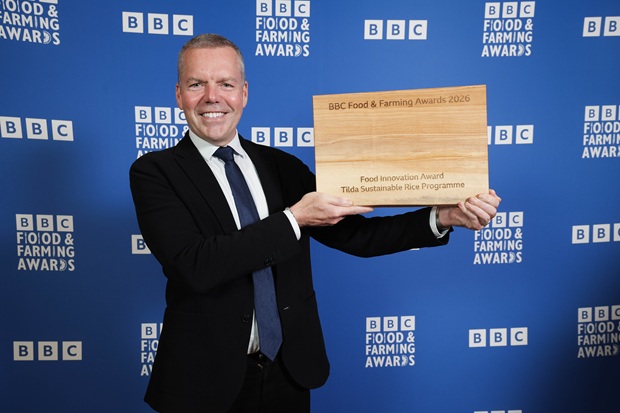 Tilda® has crowned an extraordinary year of industry recognition with a fourth major sustainability award, demonstrating how its pioneering work with basmati farmers in northern India is resonating with audiences far beyond the rice industry.
The latest accolade, the Food Innovation Award at the BBC Food and Farming Awards 2026, announced in Belfast on 21 October, completes a remarkable run of four awards recognising Tilda®’s efforts to reduce greenhouse gas emissions, conserve water and improve farmer livelihoods.
The BBC triumph follows three other significant 2026 victories: Supply Chain Sustainability Project of the Year at the edie Awards in March; Supply Chain Project of the Year at the UK Green Business Awards in June; and Sustainable Supply Chain Initiative at the Food and Drink Federation Awards in September.
Together, the awards represent recognition from four distinct audiences: international sustainability experts, the wider UK business community, the food and drink industry, and now consumers through the BBC’s national platform.
Behind the accolades lies a practical transformation in how rice is grown.
Launched in 2021 with just 50 farms, Tilda®’s Basmati Sustainability Programme supports independent farmers in Haryana and Uttar Pradesh to adopt Alternate Wetting and Drying (AWD), an irrigation technique that replaces continuous flooding with controlled wet and dry cycles, dramatically reducing methane formation and water consumption.
By 2025, the programme had expanded to 3,840 farms covering 15,314 hectares, representing 87% of Tilda-branded basmati sourcing.
Across the 2023–2025 crop years, participating farms achieved 36% lower greenhouse gas emissions and used 26% less irrigation water per tonne of rice compared with traditional growing practices. Average annual carbon savings reached 22.7 million kg CO2e, while production increased by 6.9% and farmer incomes by 7.5% compared with farms outside the programme.
Jean-Philippe Laborde, Managing Director of Tilda®, says: “Four awards from four very different audiences is an extraordinary endorsement of what can be achieved through collaboration. But the real recognition belongs to the farmers who have embraced new ways of growing rice, and our teams and scientific partners working alongside them.
“Together, we are demonstrating that environmental progress and better livelihoods can go hand in hand. We want to show what is possible when farmers, industry and science work together – and help make more sustainable rice production the norm, not the exception.”
Yet Tilda® is equally clear that recognition does not mean the work is complete.
While AWD significantly reduces methane emissions, changes in soil conditions can increase emissions of another powerful greenhouse gas, nitrous oxide, potentially offsetting some of those gains.
Tilda® is therefore working with the University of Cambridge Crop Science Centre and Ebro India to investigate whether beneficial soil fungi and bio-fertilisers can reduce dependence on synthetic fertilisers while maintaining yields and improving soil health.
Jon Calland, Head of External Affairs & Sustainability at Tilda®, adds: “We have made real, measurable progress, but we recognise that our carbon footprint is dynamic and needs to be continually assessed using data from the field. We use the Cool Farm Tool to capture the different sources of greenhouse gas emissions and understand how changes in farming practices affect our overall footprint. This helps us identify where further improvements can be made.
“Our next challenge is nitrous oxide, and we are excited to be partnering with the University of Cambridge Crop Science Centre on groundbreaking research into how beneficial soil fungi and biofertilisers could help reduce emissions, improve soil health and maintain yields. We are determined to keep testing, learning and sharing robust scientific evidence so that we can continue to improve our programme and help drive progress across rice farming more widely.”
Comments are closed.