

The use of overly perfected, AI-generated food imagery is growing in FMCG, from Nestlé’s AI-powered “digital twin” content to Uber Eats using AI to enhance food photos.
The technology is improving quickly, and for busy FMCG teams under pressure to produce content at scale, the appeal is obvious: it is arguably faster, can be cheaper and, at a glance, often ‘good enough’.
But as the use of AI grows, so does the pushback among consumers against hyper-polished, flawless visuals. A 2025 study by researchers at the University of Turin found that AI-generated images are often perceived as “strange” or unsettling, even though viewers can’t always exactly explain what feels off.
It highlights a simple point for brands: natural imperfection isn’t a defect, it’s a signal of credibility. Consumers can sense when something feels over-produced, and when they do, trust and appetite disappear, writes Alex Stewart, Creative Partner and Co-Founder, Derek&Eric.
For many brands, moving towards showing the innate bumps and textures of real-life products can feel like a risk. But in an era saturated with over-perfection, the most distinctive choice for FMCG brands is to be natural in its photography.
Embracing imperfection – and emphasising the analogue – is becoming a genuine advantage, helping brands stand out in crowded categories and build trust. Here’s how best to do it.
Embrace variety
AI can produce food imagery that looks convincing at first glance, but look closer and everything starts to look a little too smooth, a little too even, a little too generic. The yellow dots on the strawberry are too perfectly spread. The raspberry has no hairs. The lighting is perfect, but the food itself feels faintly unreal.
Show consumers photography that embraces the reality of food: not every strawberry is the exact same size, even when they’re mass-produced. Variation reassures shoppers that what they are buying will resemble the image they’ve seen, and that they can trust the brand.
Brands like MUJI are a great example of what happens when you lean into that. Their imagery is simple, but it doesn’t try to standardise the product. A biscuit might be slightly broken. A piece of fruit might be uneven. That variation is left in. The same is true of brands such as Graza or Kencko, where drips and crumbs are allowed to stay in the picture. That creates confidence because it feels honest.
Let texture do the work
One of the biggest mistakes in food photography is flattening the image in pursuit of neatness. Texture is where appetite often lives. The flakes of pastry or the squidgy middle of a dessert are the details that help people imagine the experience of eating the product.
Macro photography can be especially effective here. Barry Makariou’s work for Milka is a good example of how getting closer to the product can make it more persuasive, not less. By leaning into the texture of the fillings and the surface of the chocolate, the image feels richer.
That matters because food is one of the most physical categories there is. You are not selling an abstract proposition. You are selling something people want to bite into, spoon out, peel apart or catch the crumbs as they fall. The more distance there is between the image and that real sensory experience, the less persuasive the photography becomes.
To airbrush or not?
The real question is not whether to airbrush, but how much. Good retouching removes distractions, rather than sanitising the product into something physically impossible. There is a difference between taking out an oddity that catches the eye for the wrong reason and making so many changes to the image until it loses any sense of life.
A good test is whether the image could have been shot in camera. If it depends on impossible swirls, hyper-perfect surfaces or ingredients behaving in ways they never would in real life (even given infinite time and budget), you are creating a credibility gap. Consumers may not analyse that consciously, but they do register it. The image stops feeling like food and starts feeling like marketing.
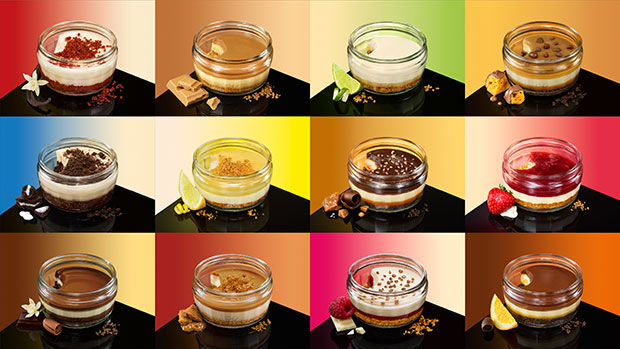
Our work with Gü shows what a more distinctive approach can look like. Rather than relying on impossibly smooth layers on a spoon, we built a fresher visual language around colour, real texture and photography shot in camera. That meant letting the product behave more naturally: layers running into one another and surfaces looking naturally uneven. As well as looking appetising, it feels more believable and more distinctive on shelf.
If you’ve got it flaunt it
If you have a product with genuinely distinctive visual features, photograph and use them. Leibniz is a good example. The biscuit itself is ownable: its shape, its stamped name, its texture. They’ve turned photos of the biscuits on the packs into their brand. It’s very beautiful and simple. It’s the same with Toblerone. In both cases, the use of photography works because the image carries the identity. It is not hidden behind effects or over-styling. If your product has something unique about it, show it.
Use food photography to build a distinctive brand world. Too many categories rely on the same visual language. Premium desserts, for example, have spent years borrowing from the same dark, moody, unreal kitchen aesthetic. Once every brand is doing it, it no longer signals quality.
The opportunity is to build something more ownable. That might mean using colour, material or composition in a more recognisable way. What matters is having a clear photographic idea that feels distinctive to your brand, rather than repeating the same category conventions.
Because the real risk is not that your food photography looks imperfect. It is that it looks interchangeable. AI will only increase that danger. It is very good at producing imagery that is good enough, but good enough is not what builds a distinctive brand. The brands that stand out will be the ones that understand what makes their product feel real, and have the confidence to show it.
Comments are closed.