

Levi Roots, born Keith Valentine Graham, is a Jamaican-British businessman, celebrity chef, musician, television personality, author, and radio presenter.
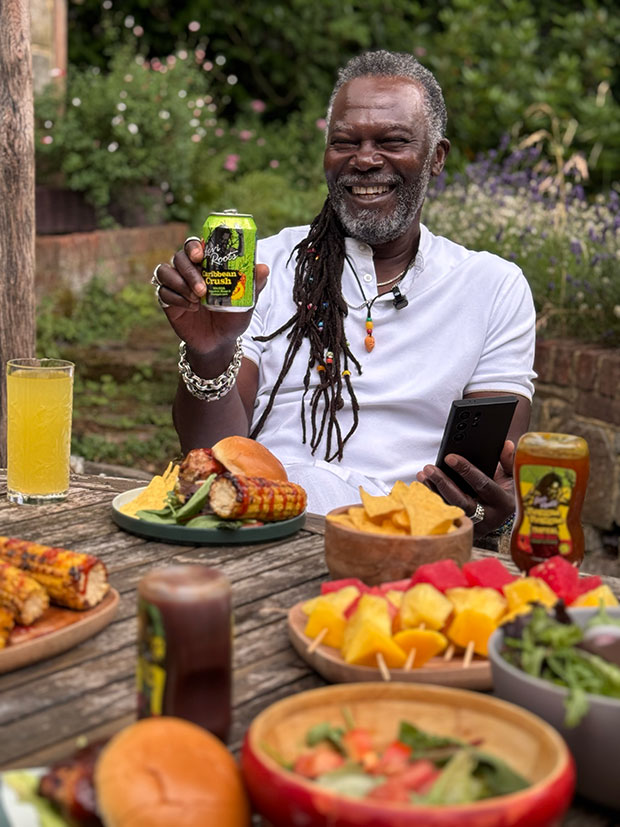 After selling his Reggae Reggae Sauce at the Notting Hill Carnival, he later took the sauce to a food trade show, where he was spotted by a BBC producer who approached him to appear on Dragons’ Den.
He successfully pitched for a £50,000 investment on the show, since when the brand has grown into a multi-million pound success story.
Levi Roots tells Wholesale Manager about his rise to fame, and the launch of his latest carbonated and energy drinks range, Reggae Sunrise.
What are your memories of your early life in Jamaica and how did it feel to move to the UK aged 11?
I lived in the village of Content, Clarendon with my grandparents while my parents worked in Britain as part of the Windrush generation. I had a lovely laid-back life where fruit grew on every tree and fish jumped in the lakes. However, my family was very poor; six of us children shared one big bed in a thatched-roof house.
I was particularly close to my grandmother, Miriam. She was my first love and my mentor. She taught me to cook something out of nothing using Jamaica’s natural herbs and spices. I was her sous-chef and I learned to sing by her side at the local Baptist church.
I spent my days outdoors, running through fields and helping my grandfather on the farm, which grew everything from sugar cane to scotch bonnet chillies. I had no formal schooling during this time and did not enter a classroom until I moved to the UK.
In 1969, I was the last of my siblings to be sent for by my parents. The move was a jarring transition for me. I hadn’t seen my parents since age four and barely knew them. Arriving in autumn, I was stunned to see trees without leaves and had never encountered the biting cold before. I remember thinking the country looked cold and dead.
Having never been to school, I entered secondary school in South London unable to read, write, or even spell my name. My mother would meet me at Tulse Hill library every evening to teach me, which helped me catch up with my peers within a year. I experienced racism almost immediately upon arrival, which was a profound shock to the system after growing up in a community where I had rarely even seen a white person.
You are a musician; you performed with James Brown and were friends with Bob Marley. What are your memories of these musical legends?
I was a friend of Bob’s when he lived in the UK. I played football with him and the Wailers every Sunday in Battersea Park, London. One time, I played as a centre-half against him, and he scored a hat-trick against me. After the match, Bob gave me a T-shirt from his Natty Dread album, which is still one of my most prized possessions. That album was life-changing for me, it was a primary reason I fell in love with music and the reggae lifestyle.
I also shared the stage with James Brown a few times, including in front of 50,000 people on one occasion. He was a cool guy, and he inspired me to persevere in the music trade.
Tell us about the invention of Reggae Reggae Sauce. What inspired the recipe?
The inspiration for Reggae Reggae Sauce was a combination of my Jamaican heritage, my grandmother’s cooking, and a desire to merge my two passions: music and food. The recipe was deeply inspired by the flavours and techniques I learned from my grandmother while growing up in Jamaica. I wanted to recapture her authentic Caribbean style rather than reproduce a static written recipe.
One major inspiration for the specific final recipe was the need for a mainstream version of jerk sauce. The jerk sauces I saw sold at the Notting Hill Carnival were too hot for some customers, so I reduced the heat to make it more accessible to a wider UK audience while still retaining traditional Caribbean spice.
Tell us the story of how you came to be on Dragons Den and secured funding. How did it feel to be given £50,000?
The moment I secured the £50,000 investment on Dragons’ Den, it felt like I had won the lottery. I had spent years facing rejection from banks and investors who didn’t believe in Reggae Reggae Sauce, so the deal represented a life-changing breakthrough. Apart from the money itself, the experience gave me the crucial opportunity to prove I could be successful and it opened doors that had previously been closed to Caribbean food businesses in the UK.
Tell us about the new Reggae Sunrise flavour. What juices are going into the flavour?
Reggae Sunrise flavour is a tropical blend primarily featuring the juices of passion fruit and papaya. The flavour profile is designed to balance the sweet, juicy taste of real passion fruit with the smoothness of exotic papaya, lifted with a sharp citrus zing.
Alongside the core soft drink, the energy variant includes a pinch of turmeric, adding both a subtle kick and a distinctive visual glow.
The Reggae Sunrise line has launched as part of the “Awaken the Nation” campaign, a multi-city sampling activation designed to drive trial and awareness across key UK locations, sitting alongside Caribbean Crush within the Levi Roots drinks range.
Available in both carbonated and energy variants, Reggae Sunrise is sold in 12-packs and as individual price-marked packs. The carbonated drink is available in 500ml bottles at £1.25 PMP, while the energy variant is available in 500ml cans at £1.19 PMP.
How is Caribbean Crush flavour performing?
Caribbean Crush is currently a top-performing staple in the beverage portfolio, serving as a primary driver for the brand’s expansion into new categories like energy drinks. Caribbean Crush 500ml is the number one selling SKU in the Levi Roots soft drinks range.
The flavour is a zesty combination of grapefruit, mango, and pineapple. It is packaged in 330ml cans and 500ml bottles.
The flavour has seen significant year-on-year growth, previously hitting +41% in value sales and consistently outperforming other Caribbean-flavoured carbonates.
The overall Levi Roots soft drinks range has outperformed the total flavoured carbonates market, growing at 32% in the impulse sector compared to the market average of just 1.4%.
We expanded into energy drinks with the launch of Levi Roots Energy Caribbean Crush. This variant adds natural caffeine and vitamins B6 and B12 to the classic grapefruit, mango, and pineapple blend.
Are people searching for more flavoursome adult soft drinks to help them reduce alcohol consumption at big social occasions?
There’s definitely been a shift in the category, especially with younger consumers, towards drinks that have more depth of flavour. People still want something that works for social occasions like barbecues and parties, but it doesn’t always have to be alcohol.
Nichols PLC, the parent company behind the drinks side of the business, has done a lot of work analysing the market, and what’s clear is that shoppers are looking for more interesting taste profiles now, something that brings a bit more excitement and variety to the soft drinks fixture, rather than the same familiar options.
Of course, there’s a bit more awareness around things like sugar as well, but not at the expense of enjoyment. If it doesn’t taste great, people won’t come back to it.
For me, that’s where Levi Roots fits in. It’s about bold, vibrant Caribbean flavours that really stand out on shelf and give people something different. We’ve always said it’s about putting some music in your glass, and that’s exactly what these drinks are designed to do.
Do you still have a restaurant business? How is that performing?
I don’t have a restaurant anymore. After Dragons’ Den, I opened the Papine Jerk Centre in Battersea. It was a community hub, and it provided school meals but eventually I closed it so I could focus on my wider business. Later I opened the Levi Roots Caribbean Smokehouse, a 134-cover flagship restaurant in Stratford. I deeply regreted it closing, I tried my uttermost to avoid it but all good things come to an end.
But the Levi Roots brand remains highly successful in the retail sector. We have over 50 products stocked in major UK supermarkets. We are also in the hospitality industry by partnering with established restaurant chains like Wetherspoons.
I would like to expand the brand internationally, by bringing some “rastaurants” to the United States.
Do you have any plans for any more books and television appearances?
I’m deeply committed to the Levi Roots brand, but I have expanded into literature and live events. I launched a new edition of the Reggae Reggae Cookbook which features over 80 recipes, including Caribbean classics like Mash-Up Eggs and Salmon St Jago de la Vega. I also launched the book Sweet, which focuses on Caribbean-inspired desserts and drinks.
I was on Celebrity Big Brother 2024, then I was on shows like This Morning to demonstrate Caribbean recipes. I get offered reality TV opportunities like Strictly Come Dancing and I’m a Celebrity… Get Me Out of Here! but I have to turn them down because they do not align with my Rastafarian beliefs or my personal brand.
What do you consider to be your biggest achievements?
My work in schools and prisons, teaching young people about entrepreneurship and life plans, is the best part of my job. I see myself as a role model for people from disadvantaged backgrounds. I have been awarded two honorary doctorates for my contributions to business and education, not bad for someone who couldn’t write his own name when he arrived in the UK.
Working with the King for over 18 years as an ambassador for The Prince’s Trust is an incredible achievement.
What are your plans for the future?
I’ve got no plans to step away from Levi Roots. People buy into the brand as much as the product, and I’m still as passionate as ever about where we can take it next.
We moved into drinks some time ago, and it’s been a really strong area of growth for us. Reggae Sunrise is the latest launch in that range, building on what we’ve already done and continuing to push bold, vibrant flavours across both carbonated and energy drinks.
Beyond drinks, we’re continuing to expand the brand into new areas. We’ve recently launched a range of chilli jams into major retailers like Tesco and Morrisons, and we’re continuing to develop our Caribbean-inspired meals, crisps and peanuts.
I want to inspire the next generation of entrepreneurs, so I’m scheduled for several high-profile talks throughout 2026, including at the Royal Agricultural University to share my “Roots to Success” philosophy. I am serving as the head judge for the 2025/2026 Uber Eats Restaurant of the Year Awards and I’m a judge for the MBCC Awards, supporting independent food businesses. I’m also a featured speaker for the 2025/26 Business Leaders Lecture Series at Nottingham Business School.
I am heavily involved in the “Windrush Food Culture” exhibition, which runs until July 2026 at the National Windrush Museum, celebrating the heritage of the Windrush generation. And I’m still active in the music scene, with upcoming appearances at events like the Boho Festival 2026.
What sets your brand apart from the others?
The brand’s distinctiveness comes from me embedding my own personality directly into the products. Customers aren’t just buying a product; they are buying into my personal journey, heritage, and the music I bring to the food and drink.
I believe people buy into people, so I intentionally made myself the brand mascot. My personality is the key to the business, as customers feel they are part of my story when they purchase the products. A core differentiator is the fusion of Caribbean cooking with my passion for reggae music. That’s where ‘Put some music in your food!’ came from, and as we’ve expanded into drinks, that’s naturally evolved into ‘Put some music in your glass!’
I have maintained brand integrity by refusing lucrative deals that clash with my values. I turned down £12 million in pork product developments because Rastafarians do not eat pork, and I have rejected alcohol partnerships to keep the brand’s focus on authentic Caribbean food.
I kept the name Reggae Reggae despite advice that it sounded “too Jamaican” or “too black”. I chose to embrace his identity as a black Rastaman from Brixton to ensure the brand remained an honest reflection of myself.
The brand is rooted in my grandmother’s secret recipe, which I used for 15 years at the Notting Hill Carnival before I was on Dragons’ Den. This history provides a sense of warmth and a homemade quality that corporate competitors often lack.
What are your brand values?
My brand is centred on the core message that “you can do it.” The business does not belong to any one person or group and my brand values are deeply rooted in my personal identity and my Jamaican heritage. It’s important to be yourself. My success came from going into the Dragons’ Den as the grounded Rastaman from Brixton rather than trying to fit a standard business mold.
Being honest about yourself allows you to ask for help and find mentors. I see setbacks as learning opportunities and I believe in hard work and perseverance.
Comments are closed.